


Vintage millinery French rose. 1910s French Flower. Hat’s trim. True vintage flower
32,50€
Pink rose, 1910s
Vintage French flower. Restored and ready to wear.
Perfect for you hair, as a hat trim, historical costumes or just collecting.
1 in stock
Description
Date: c. 1910s
Provenance: France
Size: approx. 13 × 11 cm overall; rose approx. 7 cm diameter; largest leaves approx. 6 × 3.5 cm
Materials: fabric, wire and paper
Technique: handmade millinery flower
Condition: Restored and ready to wear, with the natural patina and signs of age expected from an original early-20th-century textile flower.
This beautiful French millinery rose from around the 1910s is composed of a large naturalistic pink fabric rose accompanied by three softly textured leaves.
Made by hand from fabric, paper and wire, the flower was created as a decorative ornament of the type used on hats, clothing and fashionable accessories during the early 20th century.
The rose measures approximately 7 cm in diameter, making it substantial enough to work as an individual focal ornament while remaining easy to incorporate into a hat, hair arrangement, historical costume or other textile project.
It has been carefully restored and is ready to wear, while retaining the patina and character of an authentic century-old flower.
French Millinery Flowers Around 1900–1910
Artificial flowers were an essential part of fashionable millinery around the turn of the 20th century.
Large hats provided an ideal setting for increasingly elaborate floral decoration, and surviving museum examples demonstrate just how sophisticated these handmade flowers could be.
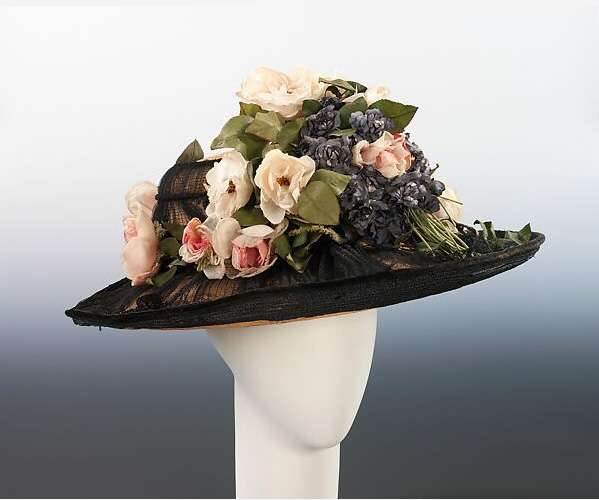
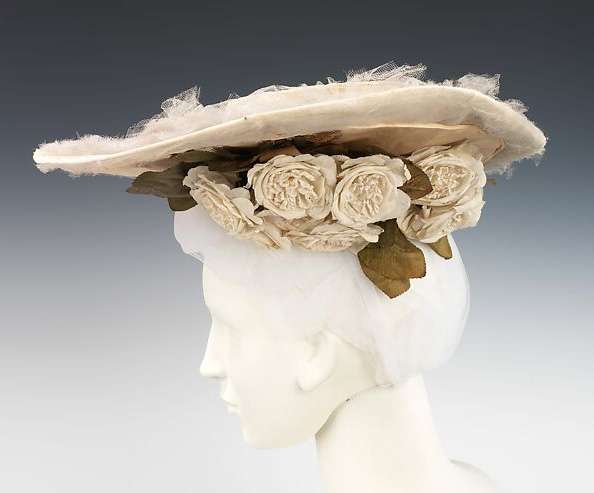
A French hat by Madame Virot, dated around 1902 and preserved at The Metropolitan Museum of Art, uses carefully concentrated floral trimming dominated by remarkably naturalistic roses. Their detailed construction shows that artificial flowers were not merely secondary accessories: the flowers themselves could be highly accomplished examples of textile craftsmanship.
By around 1910, artificial-flower making had developed into a remarkably specialised industry. Historical research cited by The Metropolitan Museum of Art records approximately 25,000 workers employed by more than 2,000 establishments in Paris alone.
Production was divided between specialists making blossoms, leaves, clusters and complete flower-and-leaf arrangements, as well as between more naturalistic and deliberately fanciful designs.
The Rose: A Prestige Millinery Flower
The rose occupied a particularly important position within this industry.
Contemporary evidence discussed by The Metropolitan Museum of Art identifies the rose as both the most popular and one of the most prestigious artificial flowers. Rose makers required considerable skill and were among the most highly valued specialists within flower-making workshops.
This surviving French rose reflects that tradition particularly well.
Its petals have been arranged to create a full, naturalistic bloom rather than a flat decorative motif, while the three textured leaves give the flower enough structure to function as a complete ornament in its own right.
The result is an excellent example of the kind of handmade floral trimming that helped define Belle Époque and early-20th-century millinery.
Ready to Wear or Collect
After restoration, the rose can once again be used as a decorative textile element.
It would work beautifully as:
- a hat or bonnet trim
- a floral hair ornament
- an addition to a historical costume
- a dress, sash or accessory decoration
- an original element for theatrical or photographic styling
- or simply as part of a collection of antique French millinery flowers
Despite being ready to wear, it remains an original antique object. Small variations, fading and traces of age are part of its history and should not be compared with a newly manufactured artificial flower.
This listing is for one original antique French millinery rose.
***Last pictures:
1901 Costume Design with Pink Roses (Percy Anderson) – Context image: Percy Anderson, Costume Design for Madame Trentoni, Act III, from “Captain Jinks of the Horse Marines”, 1901. Watercolor over graphite. The Metropolitan Museum of Art, 60.588(5). Shown to illustrate the use of pink roses as fashionable dress and costume ornament around 1900. Just as an historical reference, not included in the sale.
1887 Portrait with Rose Dress Ornament (Friedrich August von Kaulbach) – Context image: portrait by Friedrich August von Kaulbach, signed and dated 1887, showing a large rose worn prominently at the bodice. Image: Royal Collection Trust / Todd-White Art Photography. Shown to contextualise the use of roses as dress ornaments in late-19th-century fashion. Just as an historical reference, not included in the sale.
1902 French Hat with Naturalistic Roses (Madame Virot) – Context image: Madame Virot, Hat, ca. 1902. Silk and linen. The Metropolitan Museum of Art, 2009.300.2229. The Met highlights the beautifully crafted naturalistic roses as works of art in their own right. Shown here to contextualise the quality and importance of artificial floral trimming in French millinery around 1900. Just as an historical reference, not included in the sale.
1911 Hat with Artificial Roses (Mme. Pauline) – Context image: Mme. Pauline, Hat, ca. 1911. Straw, linen and silk. The Metropolitan Museum of Art, 2009.300.1602. The museum notes that oversized hats of this period provided a stage for large artificial flowers and that the rose was considered the most popular and prestigious flower within the highly specialised artificial-flower industry. Just as an historical reference, not included in the sale.
Additional information
| Flower Product | Floral Trims |
|---|
You may also like…
-


Vintage millinery roses. 1940s. French Hat’s trim. Dress ornament. Original condition. Vintage supplies
21,00€ Add to cart -

Vintage millinery flower. 1960s. French rose. Handmade, original condition. Deep purple rose
26,00€ Add to cart -

Victorian corsage 1890s French Roses. True vintage flowers
56,00€ Add to cart


Related products
-

Vintage millinery. 1900s. Grapes. French Hat’s trim. Dress ornament. Handmade, original condition.
17,00€ Add to cart -

Vintage millinery berries. 1900s. French Hat’s trim. Dress ornament. Original condition.
35,00€ Add to cart -

Antique floral cards 1900s. French. Embossed print with golden ink
15,00€ Add to cart -

Vintage millinery cherry blossom. 1900s French Flower. Hat’s trim. True vintage flower
34,00€ Add to cart


