Antique French Floral Bridal Headdress – 19th-Century Wedding Wreath
122,00€
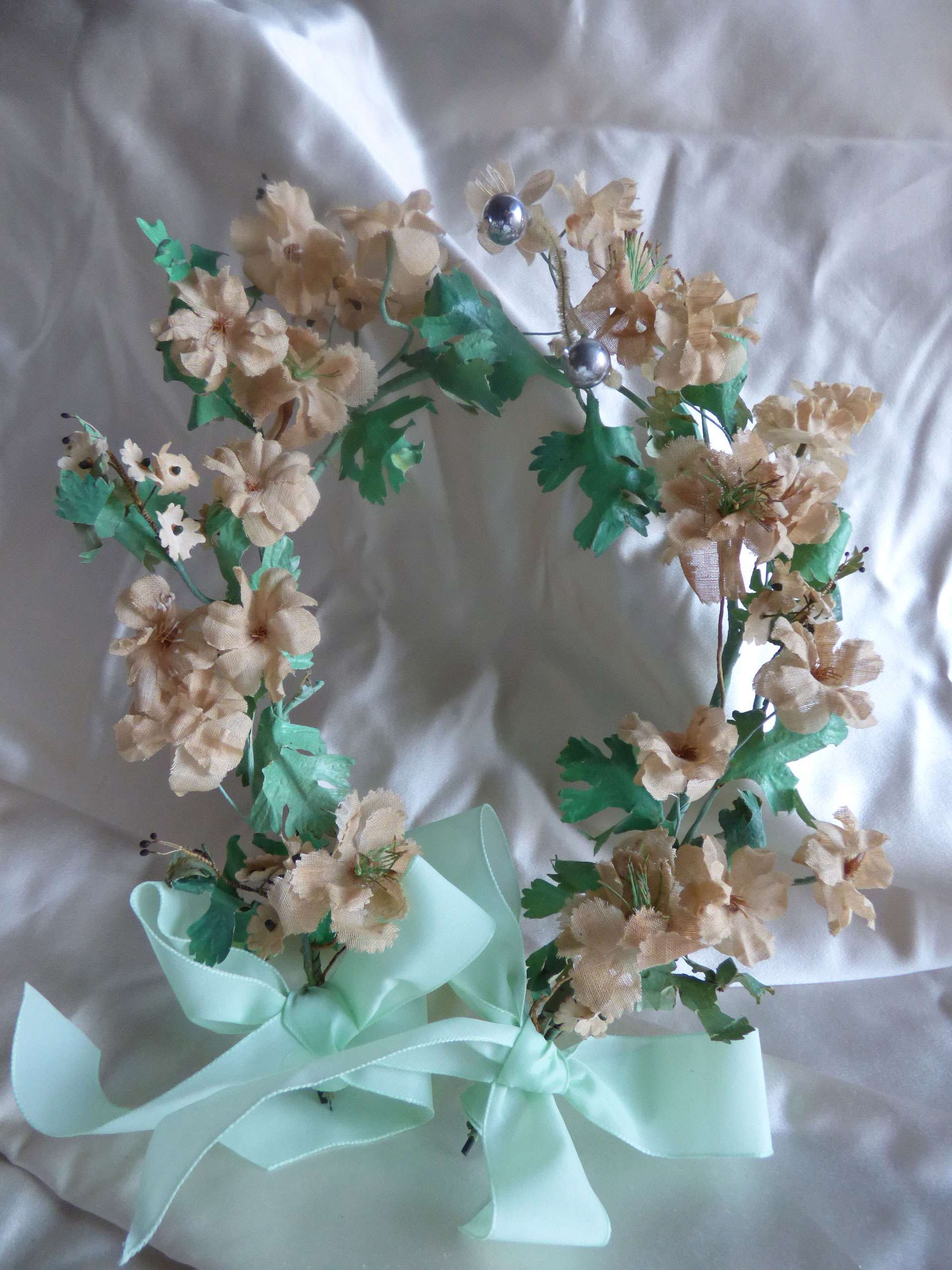
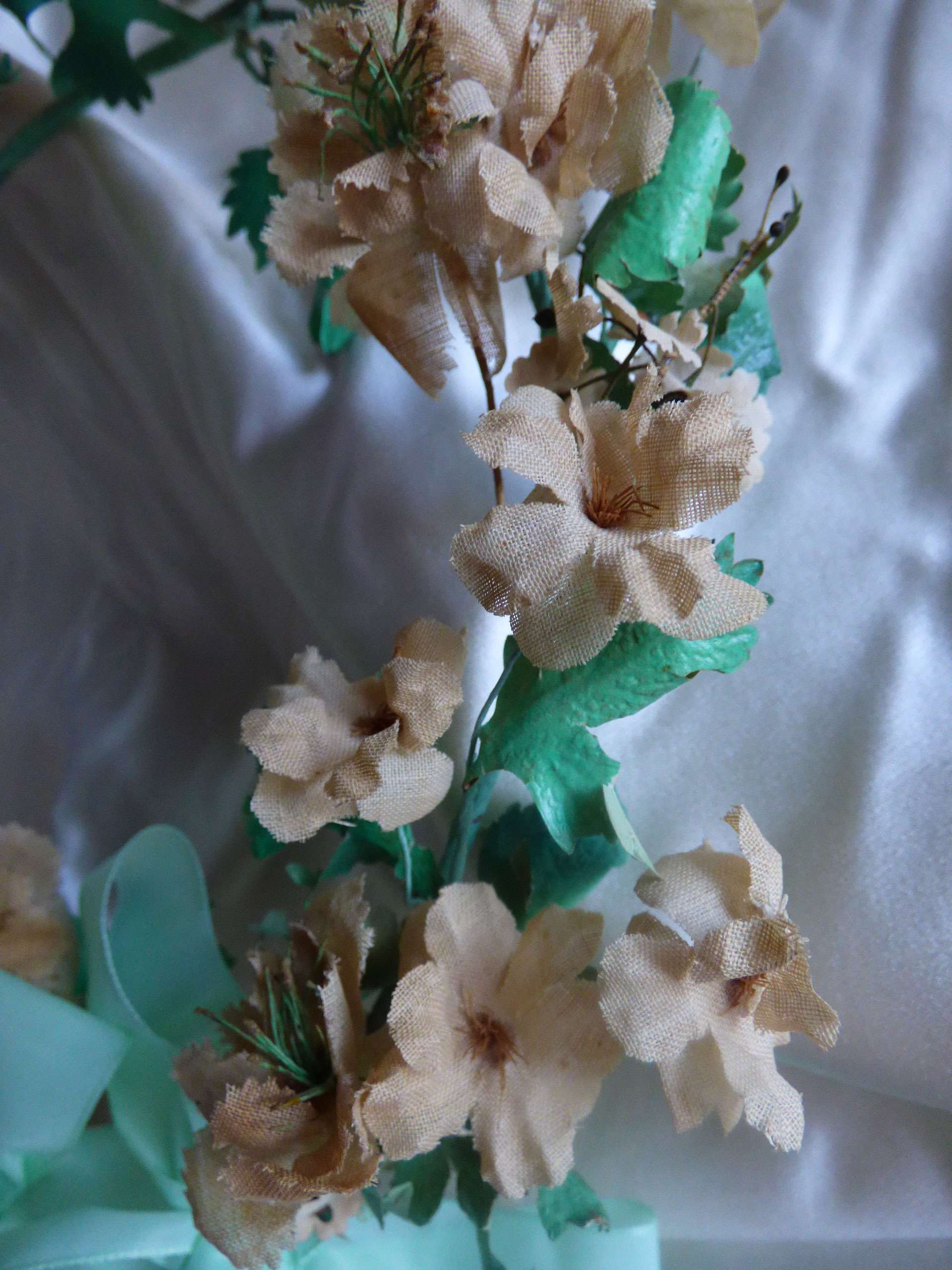
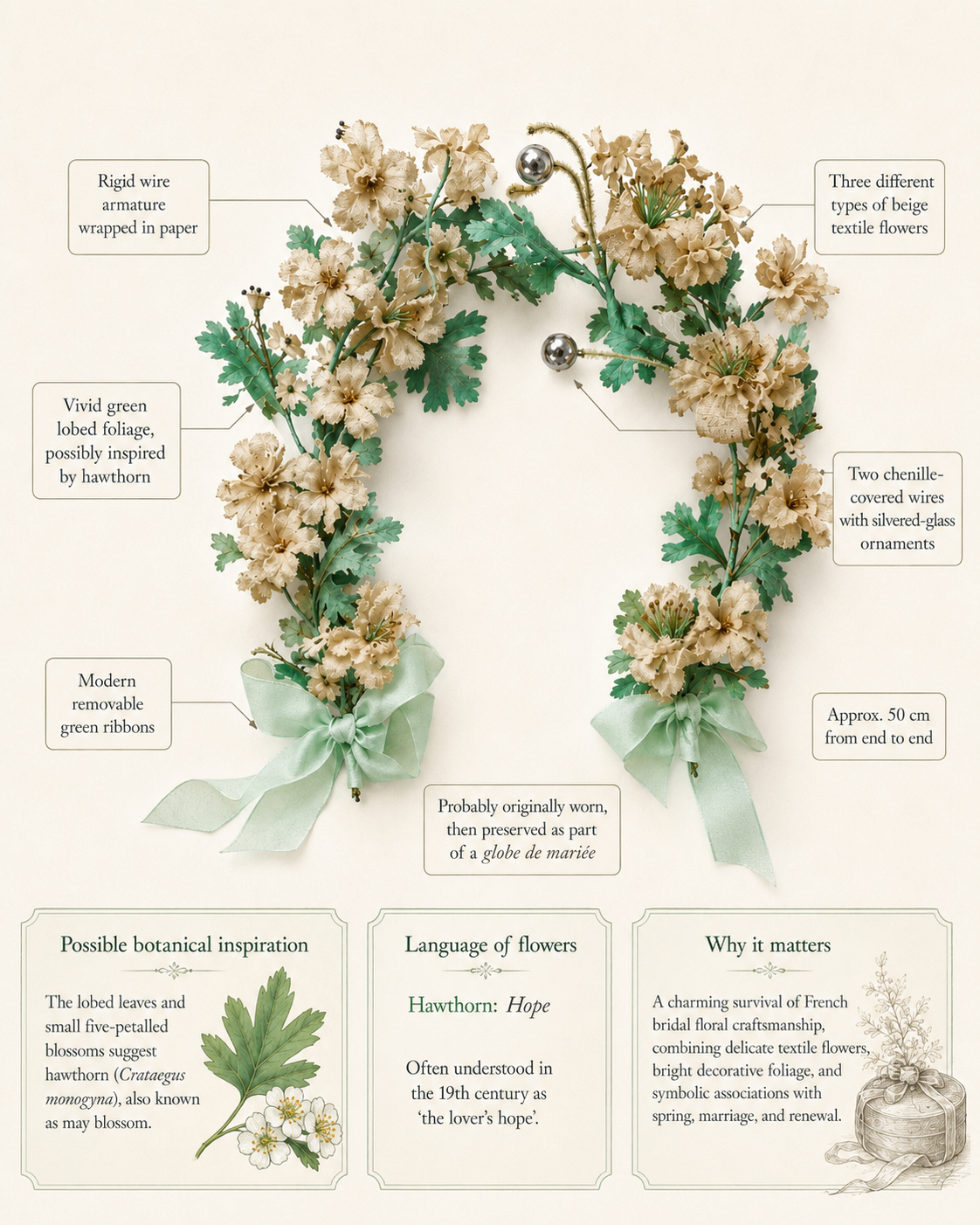
Antique 19th-century floral bridal headdress, probably French, with three types of beige textile flowers, vivid lobed green foliage and two small silvered-glass ornaments on chenille-covered wires. The rigid paper-wrapped wire structure measures approx. 50 cm from end to end and remains unrestored.
The foliage and small five-petalled blossoms may have been inspired by hawthorn (Crataegus monogyna), traditionally associated with hope, spring and renewal. The pale green ribbon ties are modern, removable additions.
Description
This unusual 19th-century floral headdress is constructed around a firm paper-wrapped wire armature and decorated with beige textile flowers, vivid green foliage and two small silvered-glass ornaments.
Although its exact history is unknown, we believe it was probably created as a wearable bridal headdress or floral wreath and later preserved as part of a French globe de mariée.
Date: second half of the 19th century, probably c. 1860–1890
Provenance: probably France
Length: approx. 50 cm from end to end
Materials: paper-wrapped wire, textile flowers and leaves, chenille-covered wire, silvered-glass ornaments
Condition: unrestored, with age-related patina
Additional elements: modern removable green ribbons
Construction and Condition
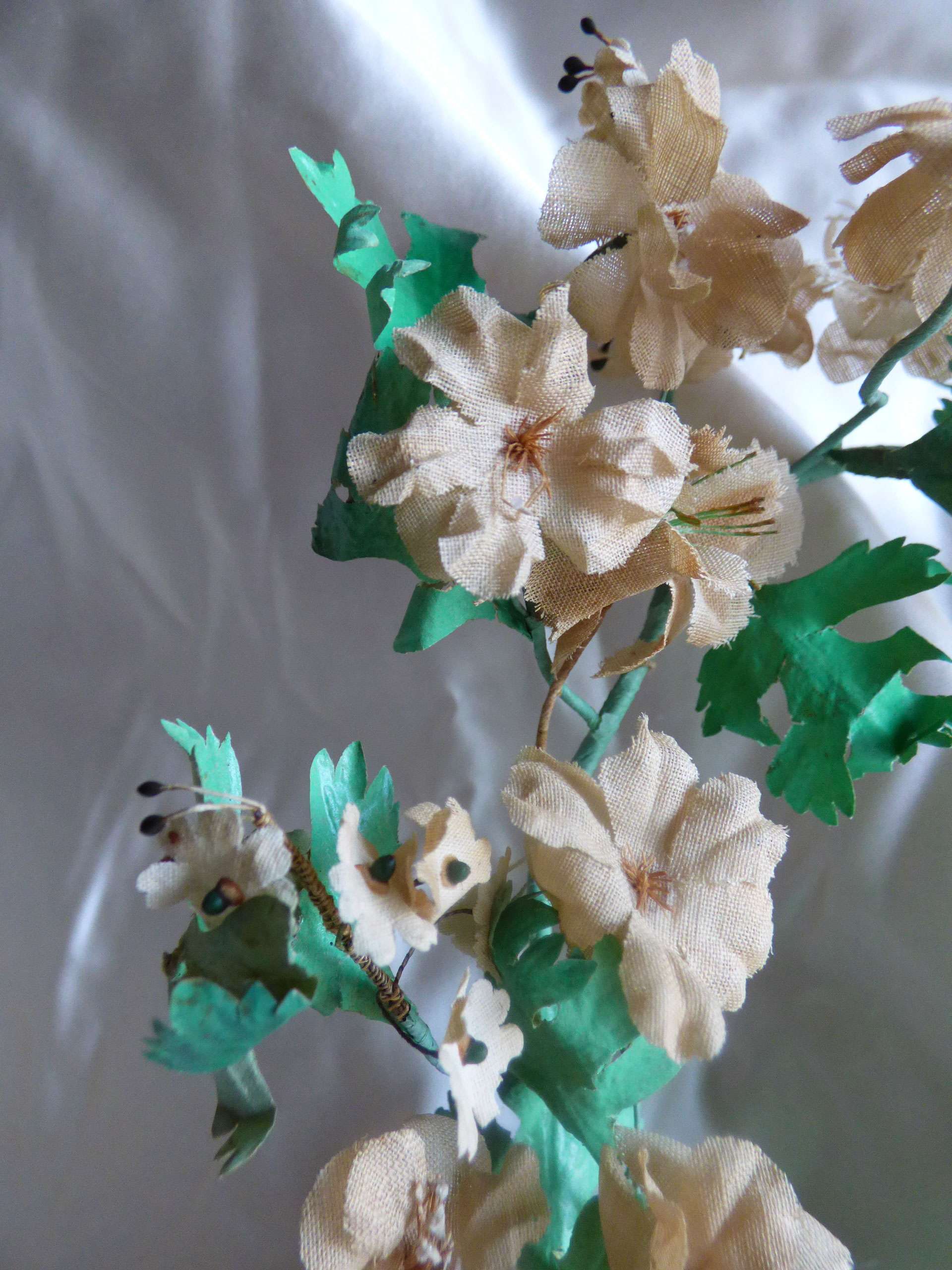
The wreath combines three different types of beige textile flowers. Larger blossoms with broad petals appear alongside smaller, more compact flowers and delicate five-petalled forms set among deeply lobed green foliage.
Rather than reproducing individual species with botanical precision, the arrangement reflects the stylised naturalism characteristic of nineteenth-century artificial floristry.
A rigid paper-wrapped wire armature follows the complete curve of the headdress, with the individual flower and foliage stems secured around it. The exposed reverse provides a particularly useful view of its original construction.
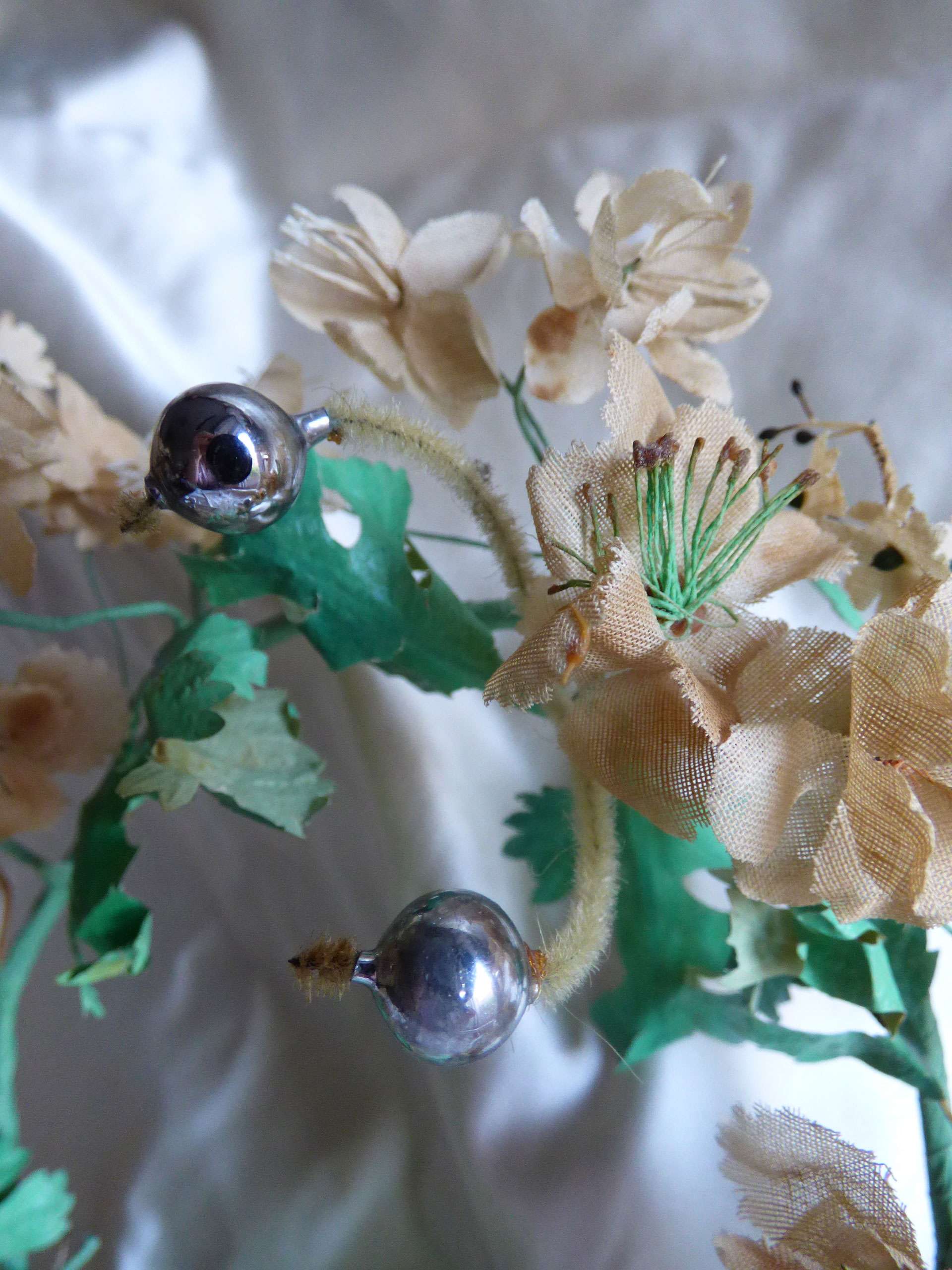
At the centre are two slender chenille-covered wires, each terminating in a small reflective silvered-glass ornament. Objects of this type are also commonly described as “mercury glass”, although nineteenth-century silvered glass did not necessarily contain mercury.
The piece remains unrestored, preserving its textile flowers, paper wrapping, foliage and glass details together with their natural age-related patina.
The pale green bows visible in the photographs are modern, completely removable additions. They were added as an optional finishing element and are not replacements for original ribbons.
Hawthorn Wreath
The distinctive foliage provides an intriguing clue to the possible botanical inspiration of the piece.
Several leaves have the deeply divided, lobed form associated with hawthorn (Crataegus monogyna), while some of the smallest pale blossoms recall its characteristic five-petalled flowers. We therefore believe the wreath may have been inspired by hawthorn, traditionally also known as May blossom.
This identification remains interpretative rather than definitive. Artificial flowers often simplified or combined botanical forms, and no surviving label identifies the species represented here. Nevertheless, contemporary decorative works demonstrate that hawthorn was readily translated into stylised ornamental designs.
An Unusually Vivid Nineteenth-Century Green
One of the wreath’s most striking features is the intense blue-green colour retained by its leaves.
The shade recalls the brilliant emerald-toned greens fashionable during the nineteenth century, including pigments historically known as Emerald Green, Schweinfurt Green and Paris Green. Arsenical greens are documented in period artificial flowers and textiles.
However, colour alone cannot identify a historical pigment, and the foliage of this piece has not been chemically analysed. We therefore make no claim regarding its composition.
What remains remarkable is the survival of such a vivid green, creating a dramatic contrast with the softly aged beige flowers.
Hawthorn, Hope and the Language of Flowers
The possible identification of hawthorn is particularly evocative in the context of a bridal headdress.
In nineteenth-century flower-language literature, hawthorn represented “Hope.” Henrietta Dumont associated it more specifically with the lover’s hope, while Kate Greenaway’s influential Language of Flowers, published in 1884, again records:
Hawthorn — Hope
The symbolism was therefore especially appropriate to courtship, marriage and the beginning of a new life together. Beyond Victorian floriography, the flowering May tree was also associated with spring, renewal and seasonal celebration.
Historical Context
Artificial floral headdresses occupied a fascinating position between fashion accessory, bridal ornament and keepsake during the nineteenth century.
A wreath such as this could originally have been worn in the hair and subsequently preserved after the wedding. In France, bridal crowns and bouquets were often incorporated into a globe de mariée, where wedding flowers and other marriage keepsakes became lasting commemorative objects.
For this reason, we consider it more likely that this piece was originally made to be worn and later incorporated into a bridal display, rather than manufactured solely as decoration for a globe de mariée.
A particularly interesting contemporary visual parallel is Herbert Gustave Schmalz’s Queen of the May (1884). The painting depicts a young May Queen wearing a crown of flowering hawthorn and carrying additional hawthorn blossom.
Historical reference: Herbert Gustave Schmalz (1856–1935), Queen of the May, 1884. Oil on canvas, 128 × 72 cm. Touchstones Rochdale, Rochdale Arts & Heritage Service, accession no. 228. Gift of Robert Taylor Heape, 1911.
The painting does not prove that the flowers on this headdress represent hawthorn, but it offers a compelling period parallel: during the 1880s, flowering hawthorn could quite literally be arranged and understood visually as a crown worn by a young woman.
The survival of this headdress therefore preserves not only a delicate nineteenth-century accessory, but also the materials, symbolism and craftsmanship of historical artificial floristry.
*Image Note
The explanatory infographic included in the gallery is an interpretative diagram intended to illustrate the construction, materials and possible botanical inspiration of the object. It should not be understood as a documentary or fully realistic representation of the antique headdress. Please refer to the original photographs for its exact appearance.
You may also like…




Related products
-
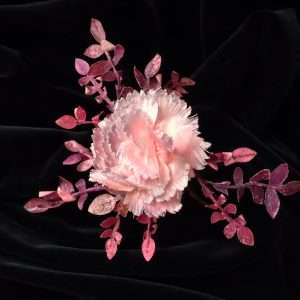

Antique Silk Carnation Corsage, c. 1890–1910
Read more -
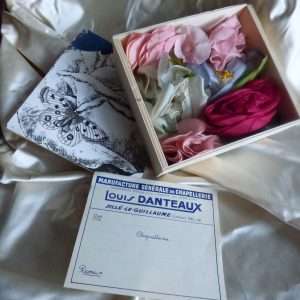
Mid-Century Handmade Millinery Flowers – Vintage Silk Roses & Floral Trims
67,00€ Add to cart -
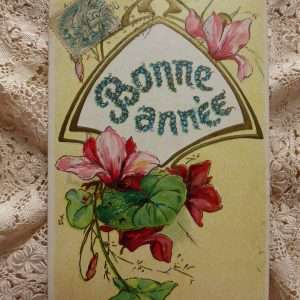
5 Antique French New Year Floral Postcards – Embossed & Gilt, c. 1900
27,00€ Add to cart -
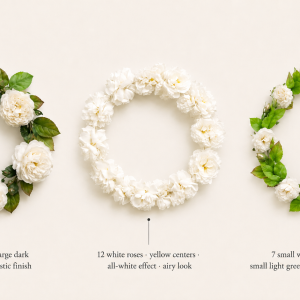
Set of 3 Antique French White Rose Wreaths – Belle Époque Floral Crowns, c. 1910
164,00€ Add to cart