Vintage gloves, handkerchiefs, millinery flowers, and wax crowns—restored with respect since 2015.
HankiesHandkisses began in 2015, first as a small Etsy shop for lace lovers. Some years later came GiardinoDiNinfa, devoted to antique flowers and the language of flowers. Gradually, the shops became something much more personal: a collection devoted to the intimate objects through which women dressed, adorned themselves and expressed who they were, what they felt and, sometimes, what they could not easily say aloud.
I’m Laura, the person behind HankiesHandkisses. I research, source, conserve, restore, photograph, describe and pack every piece myself from my atelier in Castile, Spain.
The collection began with lace. From there came dressing-table objects, glove boxes and other personal accessories; then gloves and mittens; and later one of the great decorative languages of the eighteenth and nineteenth centuries: flowers.
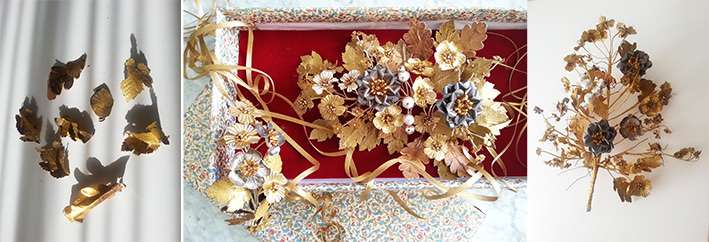
Artificial flowers led naturally to millinery flowers, floral headdresses, bouquets, corsages and bridal wax flowers. Old photographs helped me understand how gloves and accessories were actually worn. Antique postcards, which I originally collected as another source for studying flowers and the language of flowers, opened an extraordinary window onto everyday life around 1900.
In that way, the collection has grown less by following categories than by following questions.
There is also another, much simpler reason behind it.
I would love to keep many of the objects that pass through my hands, but I know that building an endless private collection would be impossible. HankiesHandkisses gives me another way of being close to them. I can find them, clean and conserve them, restore them when necessary, research their history and enjoy their company for a while before they move on to somebody else.
That time spent with each object is one of the greatest pleasures of what I do.
Small objects, private languages
What interests me most about these pieces is that they were never simply decoration.
For women living within highly regulated conventions of dress and behaviour, small personal objects could provide an unusual space for choice and self-expression.
At the highest levels of society, jewellery had long carried complex meanings through its imagery, gemstones and materials. During the eighteenth and especially the nineteenth century, the growing bourgeois world developed its own rich material culture of personal accessories.
Flowers, gloves, fans, handkerchiefs and other seemingly minor objects could become remarkably expressive.
Flowers might carry associations of love, constancy, remembrance, mourning or courtship through the language of flowers. Gloves and fans formed part of a wider world of gesture, etiquette and social interaction. A particular accessory, material, colour or arrangement could reveal taste, occasion and individuality.
These were small things, but they occupied a particularly intimate territory. They offered women ways to choose, distinguish themselves, remember and suggest. Sometimes, they also provided a way to communicate indirectly what everyday social conventions did not make easy to say aloud.
But I am also drawn to these objects for something much more immediate: the joie de vivre they can convey.
There is a particular pleasure in the artificial flowers of the Belle Époque — sprays of violets and roses, orange blossom made for weddings — and in the softness of fine kid leather or the sheen of silk. These accessories belonged to a world of dressing, visiting, theatre, dancing, weddings and social life.
They also come from a period in which specialised workshops could achieve an astonishing level of craftsmanship. Artificial-flower makers, glovers, lacemakers and other highly skilled artisans refined their materials and techniques to an extraordinary degree.
Even a very small accessory could represent many hours of specialised work.
That combination of beauty, technical skill, social meaning and sheer pleasure is a large part of what continues to fascinate me.
From Art History to material culture
My background combines Art History, fashion and the study of materials.
I trained in Fashion Design and Pattern Cutting and in Graphic Design, specialising in Illustration. Later, I completed a degree in Art History and a Master’s degree in Methods and Techniques of Historical, Artistic and Geographical Research.
I also began doctoral studies in Medieval Art History and worked in academic research and university teaching.
My early academic research focused closely on historical jewellery and textiles, particularly the sophisticated traditions of silk, velvet and brocade during the fourteenth, fifteenth and sixteenth centuries.
I studied collections in Spain and Italy. I also spent periods working with textile documentation centres, museums and other collections.
That training still influences the way I look at an object today: not only at how it looks, but at how it was made and what it meant beyond its practical use.
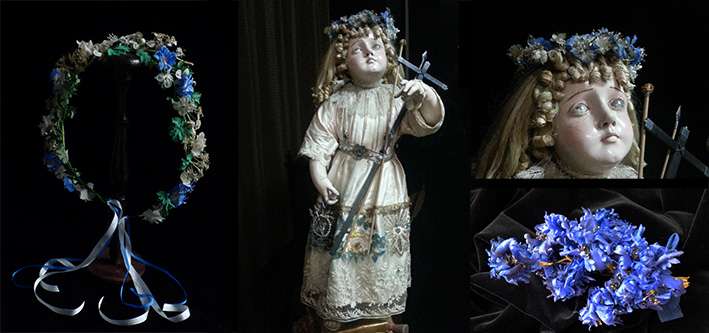
A focus on the Belle Époque
Over time, my attention moved increasingly towards women’s material culture of the nineteenth and early twentieth centuries. I became especially interested in the French Belle Époque around 1890–1910.
My interests encompass the Victorian and Edwardian periods, the French Second Empire and Belle Époque, Art Nouveau and Art Deco. I am also interested in the many historicist, neo-medieval, neo-Gothic, Neoclassical and revival styles that developed between the later Romantic period and the beginnings of the modern avant-garde.
Artificial flowers became a particular field of interest. I study the specialised ateliers that produced them in France, Belgium, the United States and elsewhere, especially from the late nineteenth century into the first decades of the twentieth.
Wax flowers are another special interest. Over time, I have learned to recognise different types of construction, botanical species and styles. I also investigate their relationship with floral symbolism and the language of flowers.
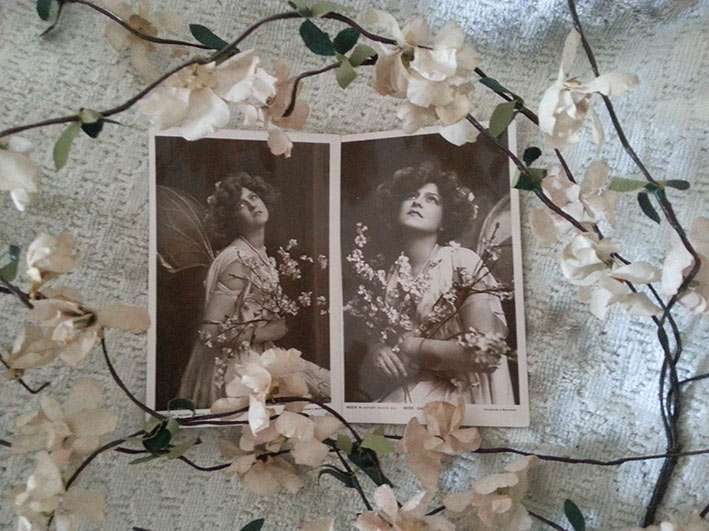
My interest in lace followed a similar path. I studied it and even began training in lacemaking myself. The technique requires an extraordinary amount of time and practice, and eventually I could no longer combine that training with everything else I was doing. Even so, the experience gave me an even greater appreciation for the skill behind handmade lace.
The people who inhabited this world fascinate me too — actresses, performers, society women and demi-mondaines among them. Objects become far more meaningful when we understand the lives, fashions and social rituals around them.
Research before attribution
Research is a fundamental part of every piece I offer.
I begin with the object itself: its construction, materials, proportions, wear, alterations and traces of previous use. From there, I look for evidence.
One of my most important methods is comparison with pieces that museums and specialist collections have already catalogued.
Other important sources include period photographs, portraits, cartes-de-visite, postcards, contemporary newspapers and magazines, manufacturers’ catalogues, fashion publications, manuals and historical books. Many of these sources explain techniques such as artificial flower making in remarkable detail.
Photographs, postcards and makers’ catalogues
Photographs and postcards are particularly valuable to me.
The enormous production of photographic and illustrated postcards around 1900 preserves an extraordinary visual record. They show how people dressed, wore accessories, arranged flowers and presented themselves in everyday life.
Manufacturers’ catalogues can be equally revealing. Some of the great artificial-flower houses produced remarkably extensive catalogues. These documented individual components, finished arrangements and changing styles.
When I can compare one of those catalogues with a surviving piece, it may provide valuable evidence for dating and identification.
My research regularly draws on online and physical resources including the Victoria and Albert Museum, the Metropolitan Museum of Art, LACMA, the Smithsonian Institution and the Bibliothèque nationale de France through Gallica. I also use Spanish archives, textile collections and specialist institutions.
My academic work first taught me to work directly with archival material and palaeography. My research included work at the Archivo General de Simancas and the Archivo Histórico Nacional, as well as provincial, local and private archives in Spain.
I have also studied collections and documentation in Terrassa, at the Instituto Valencia de Don Juan, and in Florence. Smaller diocesan, provincial and ecclesiastical collections have also been useful sources.
I research primarily in Spanish, my native language. I also read sources in English, French and Italian, translating relevant material when necessary.
Knowing where the evidence ends
Research also means knowing where the evidence ends.
If I cannot confirm an attribution to a particular date, country, workshop or use, I say so. I may explain what a piece resembles and show relevant parallels. I can also describe the evidence pointing in a particular direction, but I do not present resemblance as proof.
Sometimes the most accurate approach is simply to describe the object objectively.
That leaves the surviving evidence intact for a better identification in the future.
Conservation before cosmetic restoration
Old textiles, wax flowers, paper, wire, leather and silk can be extremely fragile. My first priority is therefore conservation and stabilisation rather than making an antique object look new.
Whenever appropriate, I begin with careful cleaning, often using gentle vacuuming.
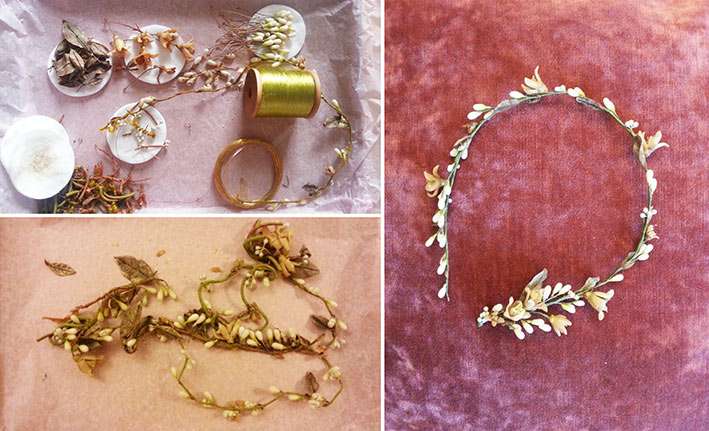
Sometimes a structural material has deteriorated so badly that it can no longer perform its function. In those cases, I may replace it with a material chosen to resemble the original as closely as possible.
When I recreate a missing element — a ribbon, a small section of stitching, a petal, leaf or stamen, for example — I use compatible materials. I also try to follow the surviving colours, construction and appearance of the original piece.
Whenever the construction allows it, I prefer additions to remain removable.
I also try to preserve the original arrangement of a piece whenever enough evidence survives to understand it.
Documenting every intervention
I describe every significant intervention in the listing.
If I have only cleaned an object, I say so. If I have restored it, I explain what I did. When a later addition is not original to the piece, I identify it clearly.
The same transparency applies to condition.
Some antique gloves, flowers and accessories can still be worn with reasonable care. Others have become too delicate and are better suited to a collection, study, photography or display.
I make that distinction clear.
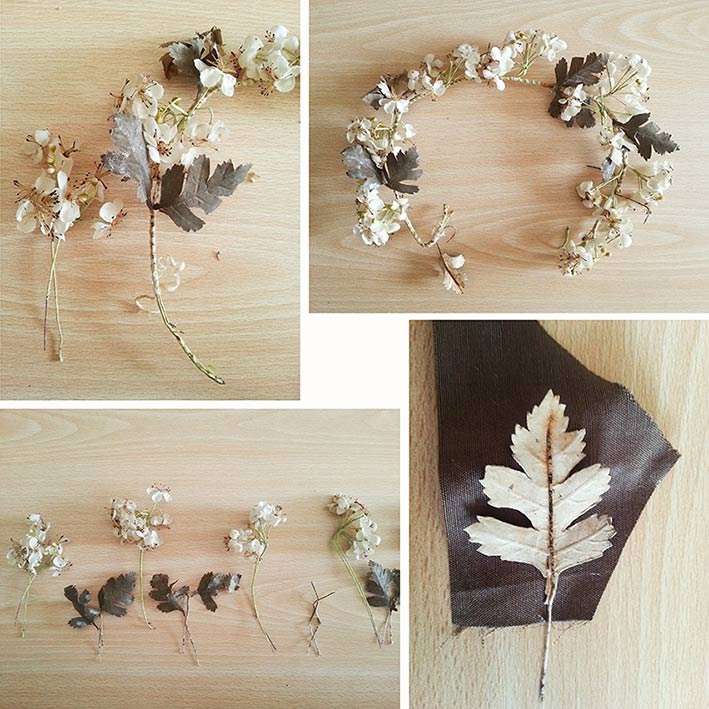
My aim is simple: when you buy a piece from HankiesHandkisses, you should understand what it is, what condition it is in, what has been done to it, whether it can safely be worn and how confidently it can be dated or identified.
You can read more about the way I assess and describe condition on the Buying Condition page.
Photographed as objects, not just products
I photograph every piece myself.
The photographs are intended not only to make an object attractive on screen, but also to document it properly.
I use a manual camera and work with both natural and artificial light. When useful, I photograph pieces against different backgrounds.
Listings normally include overall views of front and reverse. Close-up photographs show construction, materials, wear, condition and particularly interesting details.
Whenever possible, I provide measurements. In the case of gloves, I sometimes also give the corresponding size.
An antique object should never become less understandable simply because it has entered an online shop.
Sourcing the collection
Most pieces in HankiesHandkisses come from France, although I also source objects from Italy, Belgium, the United Kingdom, the United States and, occasionally, Spain.
I find them at auctions and flea markets, through private purchases and dealers, and sometimes among old commercial stock.
The collection is selective. I am especially drawn to objects that preserve something worth investigating. It might be an unusual construction, a particular material, an identifiable flower or a connection with fashion or ritual.
A surviving label or an uncommon form can also make a piece especially interesting. Sometimes, simply having enough physical evidence to understand something about its original use is reason enough to investigate it further.
Sometimes, the objects I did not acquire have been just as important as the ones I did.
Years ago, I lost an auction for a group of six beautiful Maltese lace silk handkerchiefs. On another occasion, at the monthly market in Piazza del Mercato in Siena, I missed the opportunity to buy an exceptional pair of handmade lace gloves.
Both moments stayed with me. They helped define the kind of pieces I wanted to understand, preserve and eventually offer.
Not every object reveals all its secrets. Sometimes part of the pleasure lies precisely in what remains to be discovered.
From my atelier to yours
The care I give to a piece does not end once I have photographed it.
I store the collection away from direct sunlight, with low humidity and as little fluctuation in temperature as possible.
Each object has a box selected or made according to its dimensions and fragility.
Those same boxes often become part of the shipping system. For particularly delicate pieces, I place the conservation box inside a second outer shipping box for additional protection.
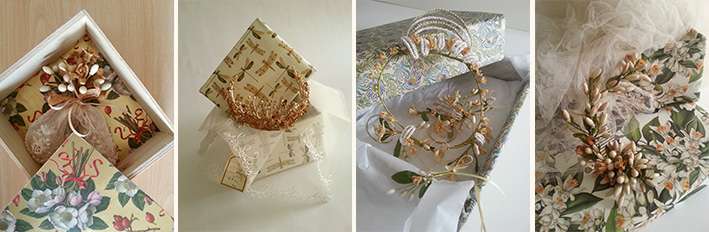
The aim is not simply to make a parcel look beautiful when it is opened. I want to give a fragile historical object the best possible chance of arriving exactly as it left my atelier.
I have been selling internationally since HankiesHandkisses began in 2015, and I ship to most parts of the world.
Over the years, these objects have gone to many different kinds of people: brides looking for an unusual antique crown or headdress or pair of gloves; collectors; historical dress enthusiasts and reconstructors; photographers; stylists; artisans and doll makers; other dealers and professionals; people working on period film and visual productions; and people who simply fall in love with a small surviving fragment of another time.
That variety feels appropriate.
People made these objects to be held, worn, chosen, given, treasured and sometimes forgotten.
For a while, they become part of my own world too.
I have the pleasure of finding them, handling them, studying them, caring for them and enjoying their company. Then, when the right person finds them, they begin another part of their history somewhere else.
That, for me, is one of the loveliest things about HankiesHandkisses.
Because an old glove, a silk flower or a lace handkerchief can tell a much larger story — and you can become part of its next chapter.